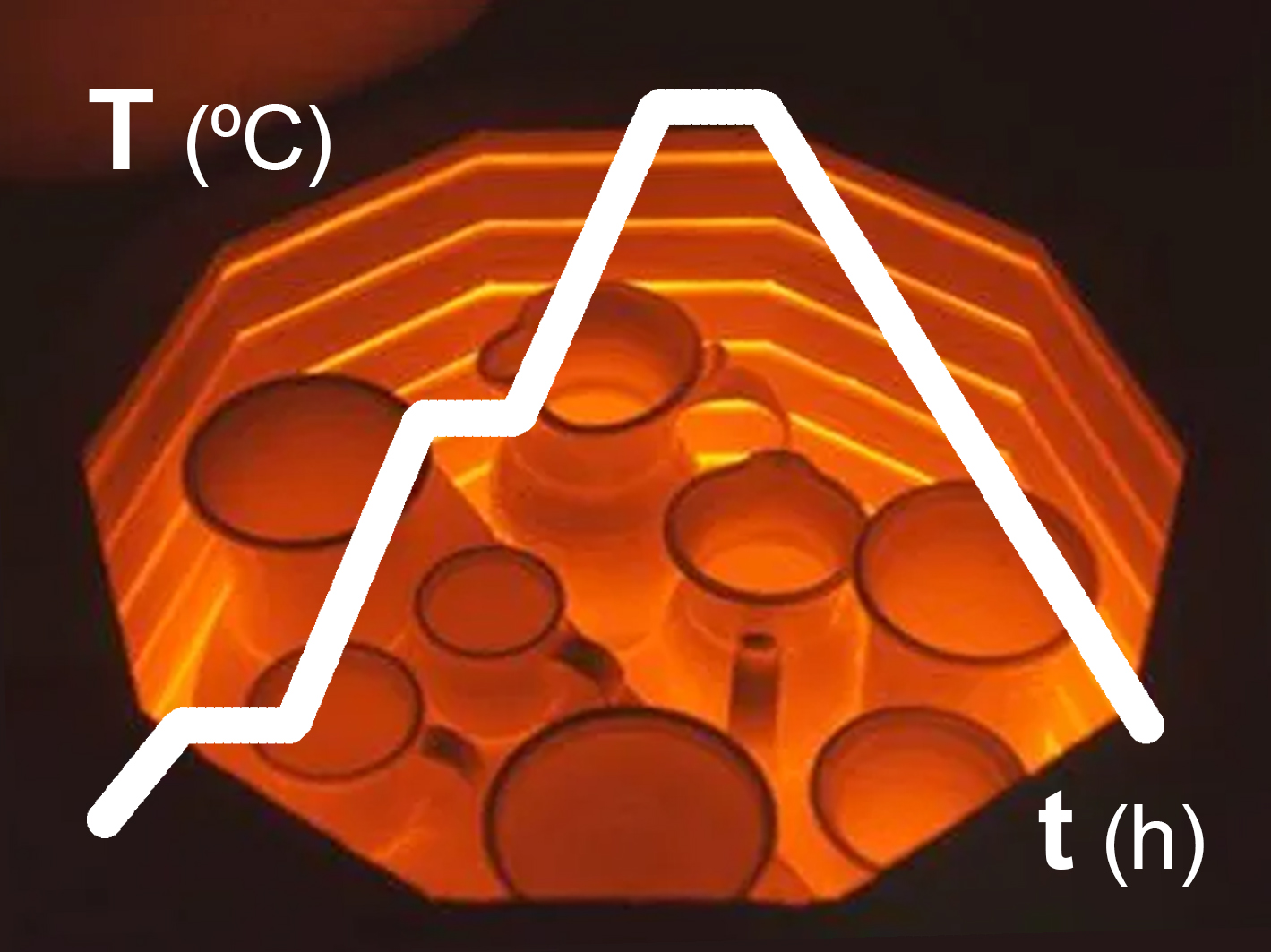
The firing curve of ceramic clays is one of the topics that generates the most questions to our technical department. Beyond the maximum firing temperature (low, medium, or high), an adequate firing curve is essential to obtain a good result, minimising the risks of breakage and defects in the pieces during firing. Below, we explain the main phases or intervals of a conventional firing and the measures that you must take in each one of them.
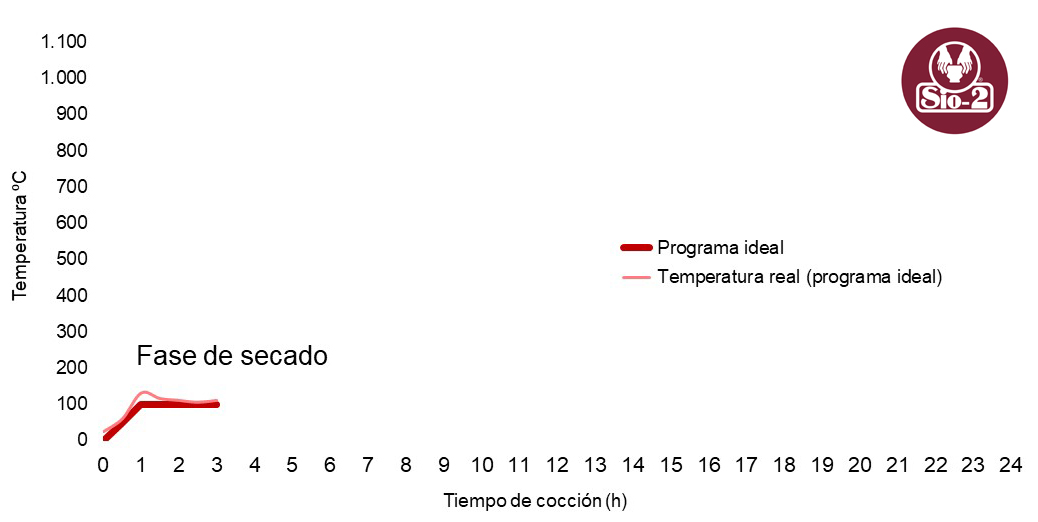
Drying phase
Range: 25 – 100 ºC
After drying the pieces in natural conditions, they continue to retain a certain percentage of humidity in equilibrium with the workshop environment. Thus, it is advisable to start the firing with a drying phase to eliminate the remaining humidity and avoid possible breakages during the subsequent heating phase.
The drying phase is carried out at 100 ºC and is maintained for a period to allow the residual humidity of the pieces to evaporate. The drying time will depend on the type of clay, the size and thickness of the pieces and the natural drying conditions prior to firing. Since the kiln consumes practically no energy at 100 ºC, it is better to over-explode the time than to under-explode it. If the kiln has a damper, it should be open to allow moisture to escape.
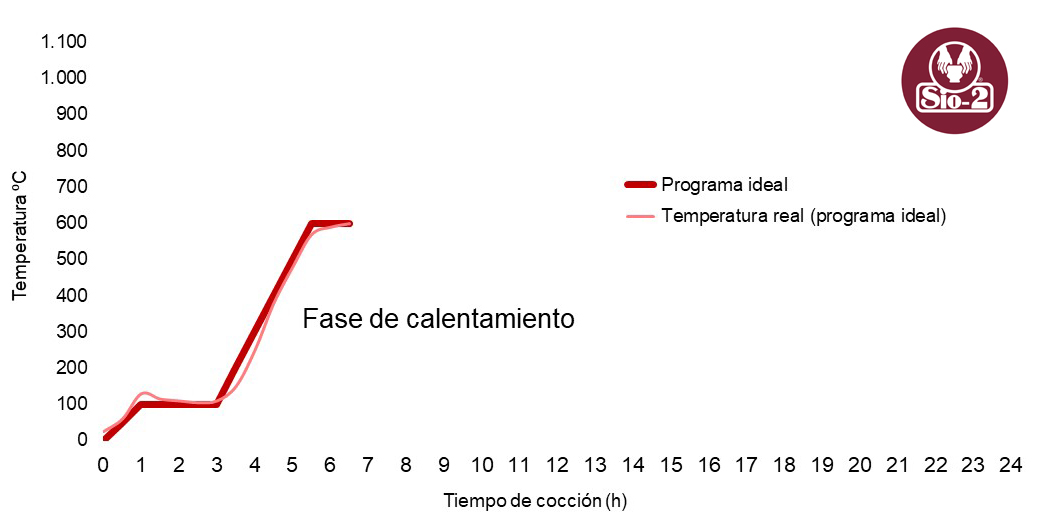
Heating phase
Range: 100 – 600 ºC
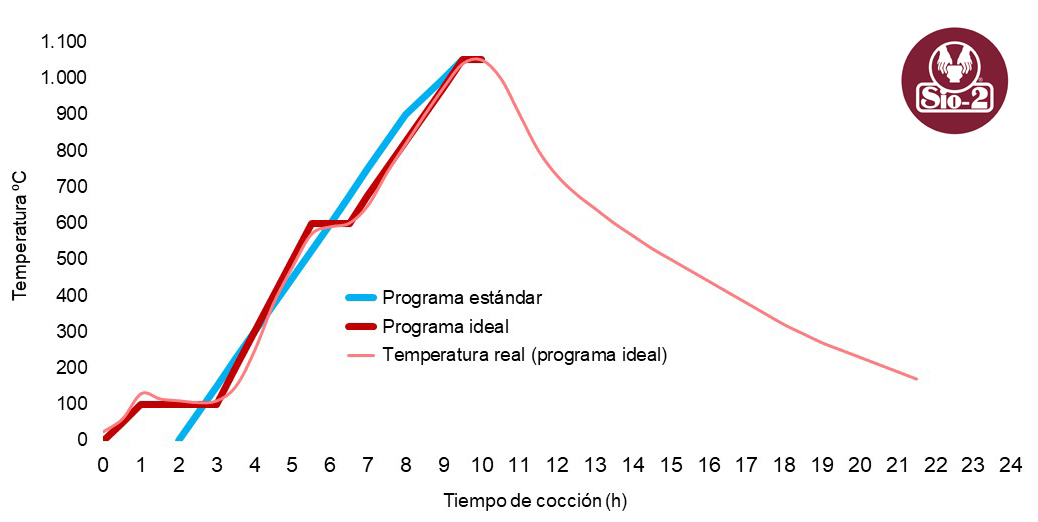
Once the drying phase is complete, the heating phase begins up to 600 ºC, normally at 200 ºC/hour. Once the temperature has been reached, it is advisable to maintain a time interval to facilitate the allotropic transformation of the quartz and the evaporation of the structural water from the clay minerals. If your kiln's programmer does not allow maintenance at 600 ºC, set the heating to this interval at 100 ºC/hour. The kiln damper remains open during the heating phase.
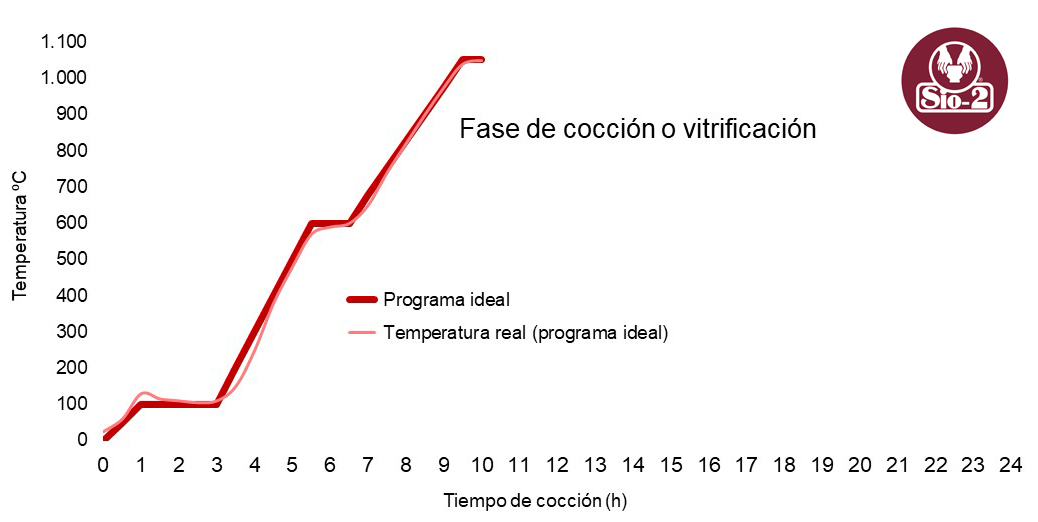
Vitrification phase
Range: 600 ºC - T max
After finishing the heating, we close the damper and start the actual firing. In this stage, most of the physical and chemical changes that transform the clay material into a durable ceramic material occur. The temperature increase in this phase is usually 150 ºC/hour until reaching the maximum firing temperature.
Once the maximum temperature is reached, it is recommended to carry out a 30-minute maintenance or “palier” to ensure the complete and homogeneous firing of all the fired material.
Cooling phase
Range: T max - 100ºC
After finishing the maintenance at the maximum temperature, we open the damper and let the kiln cool naturally. It is recommended not to open the kiln door prematurely until it is below 100 ºC. In this way, we will avoid possible breakages caused by thermal shock and the cracking of the glaze.
Standard program
The graph shows the ideal firing curve together with a standard program from a kiln manufacturer, based on 2 simple ramps.
The standard program does not include the drying phase, which is very convenient, as explained above.
Temperature control
Temperature control in the kiln is essential to ensure successful firing. Modern kilns are equipped with sensors and controllers that monitor and adjust the temperature to the firing curve throughout the cycle, thus ensuring uniform and repeatable firing.
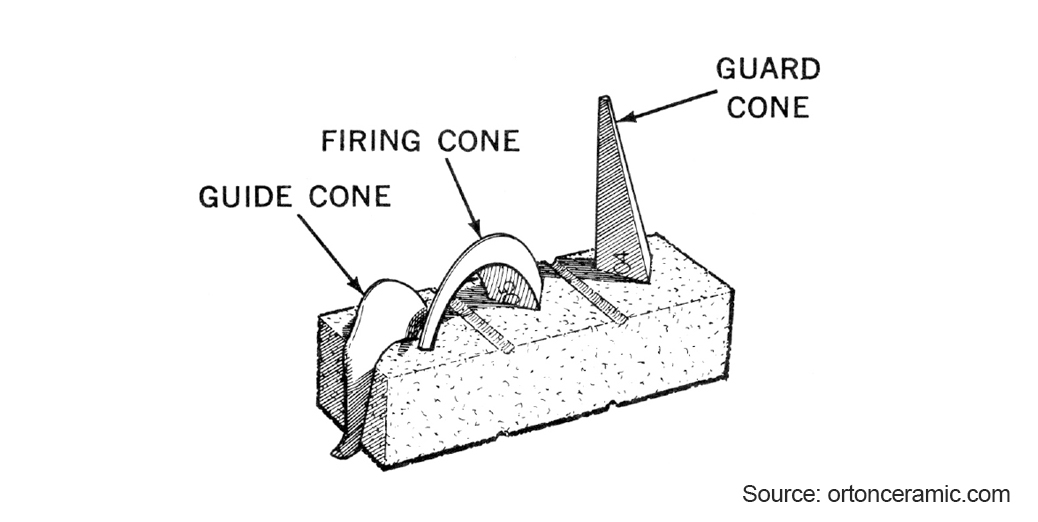
When in doubt, the use of pyrometric cones is recommended to verify the actual heat received by the pieces during firing. Heat depends on the kiln temperature, but also on the time in each temperature range, especially in the maximum temperature range. Pyrometric cones are designed to melt based on the heat received, so they begin by softening and end by bending. The final shape of the cone gives us a very precise visual indication of the actual heat reached inside the kiln. Three cones are usually used: the guide cone, which corresponds to a lower temperature and will completely bend when resting on the support; the firing cone, which corresponds to the desired temperature and which will bend, and the guard cone, which corresponds to a higher temperature and which must remain intact. If the fusion of the cones does not correspond to the expected result, it indicates that the actual heat received by the pieces has not been correct, either due to a defect (the firing cone has remained intact) or due to an excess (the guard cone has bent).
Comments (18)
chatel
2025-05-21 21:52:26
Bonjour, est ce que ces paliers correspondent aussi pour la cuisson porcelaine ?
SIO-2
2025-05-23 13:11:53
Oui, la courbe de cuisson présentée dans le blog peut servir de référence pour la porcelaine. Nous vous recommandons de vous assurer que la température finale ainsi que le temps de maintien (palier) soient bien adaptés au type de porcelaine que vous utilisez.
ROSA
2025-07-05 02:47:50
Hola! Como debería ser la curva de segunda quema, para esmaltes de 1046 grados?
Entiendo que la meseta final debe ser a 1046 por 10 a 15 minutos y luego enfriamiento. Pero no se cuantas hora debería demorarse en subir a 1046.. sería genial si me ayudan. Gracias!
SIO-2
2025-07-21 09:25:45
Para una segunda quema (cocción) con esmaltes que maduran a 1046 °C, efectivamente es importante mantener una meseta final de 10 a 15 minutos a esa temperatura, como bien indicas. Esto asegura una correcta maduración del esmalte.
En cuanto al tiempo de subida en una cocción de esmaltado (bicocción), dependerá del tipo de horno y de la carga, entre otros factores. En líneas generales, podrías subir hasta 600ºC en unas 4h y en unas 3h hasta la temperatura deseada de 1046ºC. Llegados a este punto, mantén la temperatura unos 15 min y dejada enfriar el horno de forma natural, sin abrir hasta que no haya bajado de 100ºC.
Vinc.
2025-08-11 13:39:01
bonjour , pouvez-vous me détailler une courbe de cuisson idéal pour cuire de la porcelaine à 1300°
SIO-2
2025-09-01 09:31:04
De manière générale, la courbe que nous présentons dans le blog peut convenir jusqu’à 1300 °C. Le palier recommandé peut être de 20 à 30 minutes, selon l’épaisseur de la pièce à cuire.
Christine
2025-11-07 23:28:04
Bonjour , les recommandations du fournisseur de ma terre qui est GSA ( grès de Saint Amand) préconise de cuire à 50 degré par heure entre 450 et 600 degrés. Si je fais votre courbe , qu'est ce que ça risque ? Merci
SIO-2
2025-11-11 15:16:00
La recommandation du fabricant de votre terre d’augmenter la température de 50°C par heure entre 450°C et 600°C vise à faciliter l’élimination des matières organiques, la transformation allotropique du quartz ainsi que l’évaporation de l’eau structurale des minéraux argileux (principalement la kaolinite dans les pâtes de grès). Ce ralentissement entre 450°C et 600°C correspondrait au palier proposé dans notre courbe à 600°C. Si vos pièces sont de grande taille, nous vous recommandons de suivre les indications du fabricant, qui sont plus conservatrices que la courbe que nous proposons (plus simple et adaptée à des conditions standard).
Jose
2025-11-10 00:43:13
Para hornear filtros ecológicos donde el carbón activado no debe desaparecer. Que temperatura recomiendas? He visto videos que dicen a 750 grados pero las piezas a esa temperatura están todavía como crudas. No muy resistentes como tiestos y el agua las desintegra.
SIO-2
2025-11-11 15:24:34
El carbón comienza a descomponerse y a quemarse a partir de los 500-600°C. Por ello, no se recomienda someterlo al proceso de cocción cerámica, ya que en este se alcanzan, como mínimo, temperaturas de 800-900°C. La mejor opción es cocer primero la arcilla por separado y añadir posteriormente el carbón activado, evitando así su exposición a altas temperaturas que podrían destruirlo. De este modo, se conservan tanto la resistencia de la pieza como la funcionalidad del carbón.
Andrea
2025-11-20 09:34:56
Buen día, me podrán enviar un programa para cocción de gres. Gracias.
SIO-2
2025-11-24 15:36:43
Para el programa de cocción de un gres, te recomendamos seguir la curva estándar descrita en este blog, ya que ofrece una base sólida para la mayoría de piezas cerámicas. En cuanto a la temperatura máxima, es importante ajustarla a las indicaciones del fabricante. En en el caso de una pasta de gres, lo habitual es trabajar alrededor de 1240 °C, salvo que se especifique lo contrario. Ten en cuenta, además, que si vas a cocer piezas muy voluminosas o con geometrías complejas, o si tu horno está muy cargado, es aconsejable prolongar los tiempos en cada etapa para asegurar una maduración uniforme y evitar tensiones internas. Un calentamiento y enfriamiento más pausados son recomendables en situaciones más complejas.
Paula
2025-11-29 20:05:25
Hola , porque una pieza totalmente plana ya con una primera quema bizcocho , la esmalto la vuelvo a poner al horno a segunda quema y me salen curvadas ?
SIO-2
2025-12-01 15:13:42
Las piezas planas bizcochadas pueden deformarse durante la cocción del esmalte (segunda cocción) cuando el coeficiente de dilatación del esmalte es mayor que el de la pasta. En estos casos, especialmente con esmaltes de fuerte agarre, el esmalte se contrae más durante el enfriamiento y ejerce tensión sobre la pieza, provocando arqueos o curvaturas. Para minimizar este efecto, es útil aplicar el esmalte en capas más finas y uniformes, evitar esmaltes con coeficiente muy superior al del soporte y, si es posible, equilibrar tensiones esmaltando también la cara posterior. Cocer las piezas sobre placas refractarias planas, reducir la velocidad de enfriamiento y evitar soportes excesivamente delgados también ayuda a mantener la planitud.
Noe
2025-12-11 21:38:39
Hola! Tengo un horno de muestras de 3litros y realizó piezas muy pequeñas, me conviene hacer esta misma curva respetando la cantidad de horas o puedo acelerar el proceso? Si es así que recomendaciones podrías darme. Gracias!
SIO-2
2025-12-15 15:10:12
Si trabajas con un horno de muestras y realizas piezas muy pequeñas, no es necesario respetar la misma cantidad de horas de cocción que para piezas grandes. El calor llega más rápido al centro, por lo que puedes acelerar un poco la curva, siempre cuidando que la subida de temperatura sea constante y que no se superen los límites de temperatura recomendados. Incluso en piezas pequeñas, un enfriamiento gradual ayuda a evitar grietas y tensiones internas, logrando resultados uniformes y seguros en menos tiempo.
A. María
2025-12-14 20:00:10
Hola, ¿Cómo puedo controlar la curva de temperatura de la cocción, en un horno de gas de dos quemadores? Nada más encenderlo marca una subida de temperatura rápida y al cerrar la puerta del horno, a la hora marca una subida de 400ºC. Por otro lado, es real dicha temperatura? (ya que el pirómetro se encuentra cera del quemador). Gracias y un saludo.
SIO-2
2025-12-16 11:56:52
En los hornos de gas es habitual que la temperatura suba muy rápido al inicio de la cocción, especialmente al encender los quemadores y al cerrar la puerta del horno. Esto se debe a que los quemadores trabajan a alta potencia y el horno aún no tiene masa térmica caliente que estabilice la subida. Además, cuando el pirómetro está ubicado cerca del quemador, suele indicar temperaturas más altas que las reales, ya que mide el calor directo de la llama y no la temperatura media del interior del horno ni de las piezas. Por este motivo, las temperaturas indicadas no siempre representan la cocción real. Para un mejor control, es recomendable regular el gas de forma progresiva, controlar la entrada de aire y verificar la temperatura con conos pirométricos o sensores colocados en zonas más neutras del horno. Aunque la curva de cocción en hornos de gas nunca es tan precisa como en los eléctricos, con una medición adecuada y una regulación cuidadosa se puede conseguir una cocción estable y repetible.
New comment
You need to login or create account
Save products on your wishlist to buy them later or share with your friends.
Comments (18)